
Two viewpoints worth the stop
Start at the cross that marks the westernmost point of mainland Europe. Face the Atlantic and look to your left. In calm conditions, follow the public path downhill to a second lookout.
At the cross, your eyes go straight out to sea. A little lower down, the shape of the coast comes into view and you can watch the swell break below the cliffs. Those two views are what we’d make time for at Cabo da Roca. Check the wind at the cape before you set out.
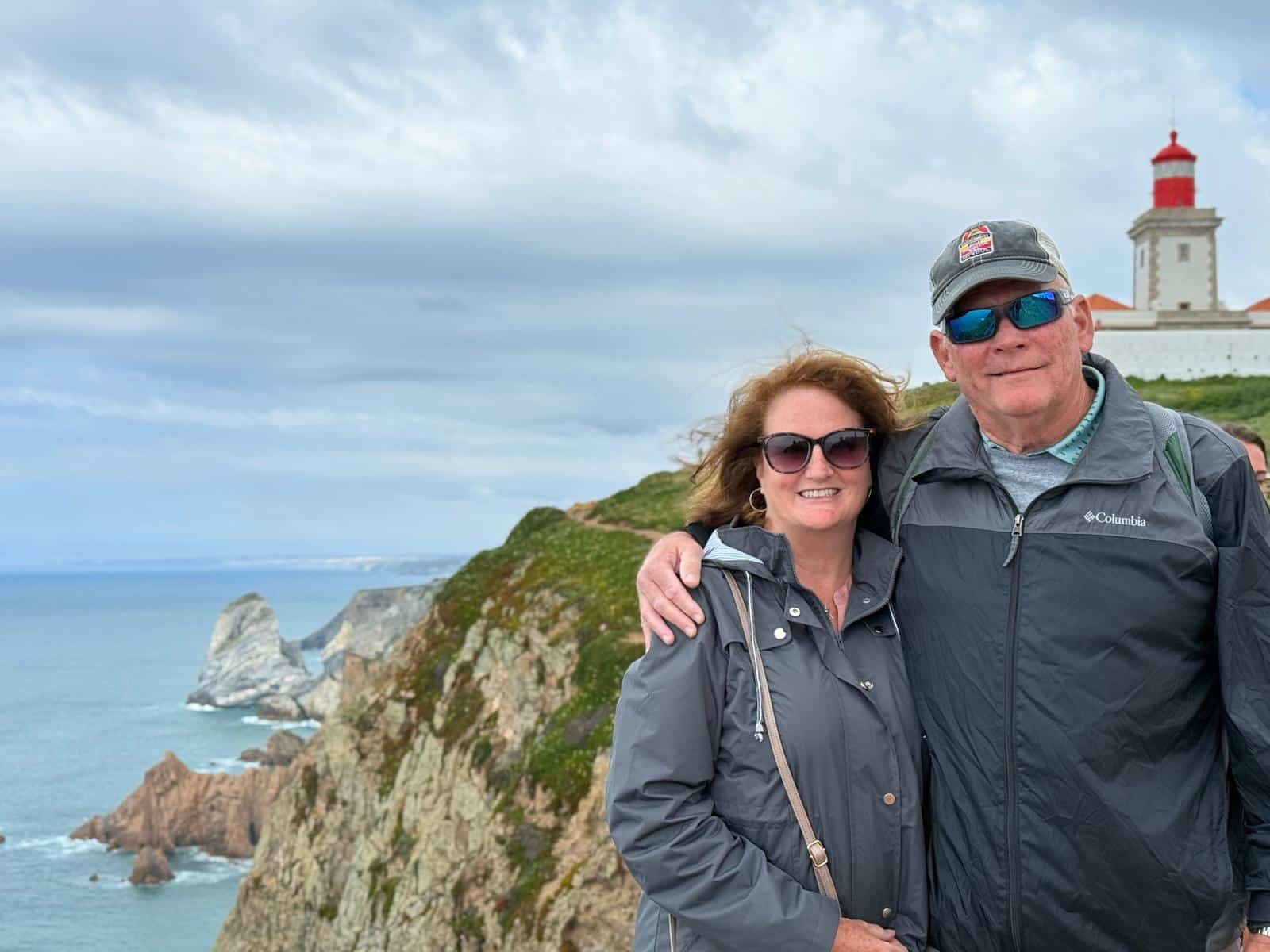
The two public viewpoints at Cabo da Roca
Both lookouts are free. Start at the cross for the landmark and the open horizon. If the weather is calm and the path is open, take a little more time for the view further down.
-
The cross at the edge of mainland Europe
Walk out to the stone cross. This is the landmark that marks mainland Europe’s westernmost point. Give yourself a moment to look beyond the photographs and read the words carved on the monument. Then turn around and see how the red lantern of the lighthouse sits above the headland. Visit Portugal’s guide to Cabo da Roca.
-
The lower lookout on your left
From the cross, face the Atlantic. The public path on your left leads down to the second lookout. From there you can look along the cliffs and see the water breaking at their feet. Wear shoes with grip, give yourself time to walk back up and keep behind the barriers. On a breezy day, the view from the cross may be the whole stop.
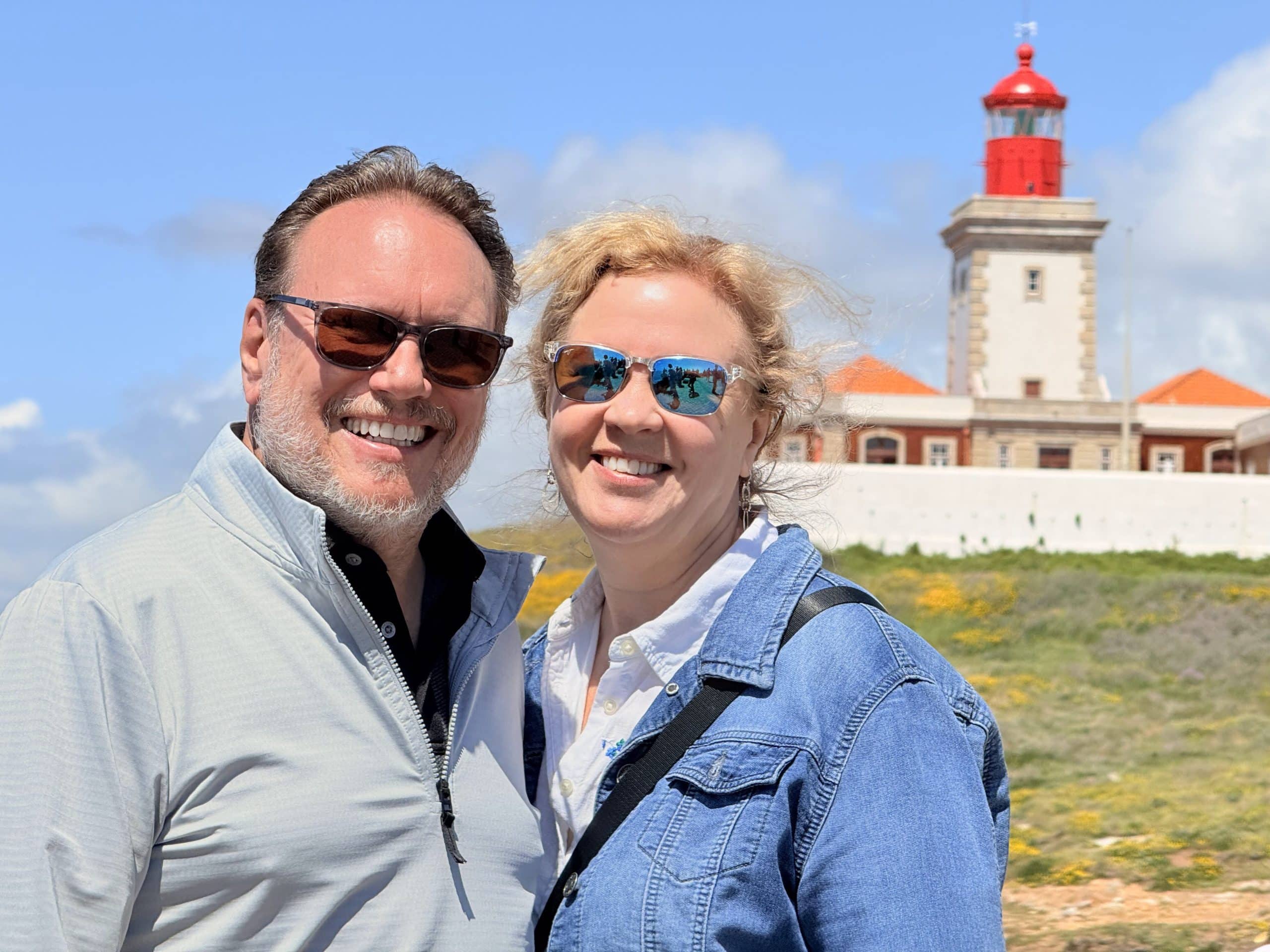
Camões, the fort and the lighthouse
The words on the cross come from Os Lusíadas, the epic by Luís de Camões. He describes Portugal as the place where the land ends and the sea begins. Read that line with the Atlantic in front of you and it’s easy to see why it belongs here. Visit Lisboa’s account of the cape and Camões.
Long before people came here for photographs, this stretch of coast helped watch over the approaches to Lisbon. Records place a fort at Cabo da Roca in the seventeenth century as part of the coastal defences. Later, the Marquis of Pombal ordered a series of lights along the Portuguese coast. The light at Cabo da Roca began operating in 1772. It went electric in 1897 and still helps ships find their way along the coast. History of the cape and its fort · Portuguese Maritime Authority’s lighthouse history.
If you’re especially interested in lighthouses, Parques de Sintra offers separate ticketed visits. For a day in Sintra, we’d spend our Cabo da Roca stop at the two public viewpoints and keep the rest of the day for the places you’re most keen to see. Official lighthouse visitor information.
Wind, coastal trails and Praia da Ursa
Check the forecast for the cape itself
Cabo da Roca can feel much windier than the sheltered streets of Sintra. Check the forecast on the day, including gusts and visibility. Bring a layer you can close against the wind and stay on the public paths, well back from the cliff edge. If gusts make it hard to walk steadily, leave the lower lookout for another day. During strong wind warnings or poor visibility, choose a more sheltered stop. IPMA’s Cabo da Roca coastal forecast.
Give Praia da Ursa a separate window
From Cabo da Roca, allow around 45 minutes just for the difficult descent to Praia da Ursa. That’s our local planning estimate from the cape, with the actual time depending on your route and footing. The path is steep and uneven, and the climb back can take longer. Treat it as a separate hike for people who are comfortable on rough ground, with grippy footwear, suitable weather and enough daylight for the return. Visit Portugal’s Praia da Ursa access information.
The wider Sintra–Cascais Natural Park has trails for different abilities. Many of the coastal paths around the cape are exposed or demanding. If you want a longer walk, check a marked route’s distance, terrain and difficulty before you choose it.
How much time to leave at Cabo da Roca
Allow around 30–45 minutes at the cape for the two public views in good conditions. Add time for the journeys and any wait for your return ride. Praia da Ursa needs its own time for the descent and climb.
This is a popular stop, and tour coaches can arrive together. If there’s a crowd by the cross, take in the horizon while people finish their photographs. If you’re staying for sunset, check the weather and arrange the return before you go. A sunny afternoon in Sintra can still feel cold and windy on the headland.
How to get to Cabo da Roca and back
Look up the Cabo da Roca stop, number 171951, in Carris Metropolitana. Use your travel date and check both directions before leaving. Keep the return departure and the station name handy. Cabo da Roca stop and departures.
-
From Sintra railway station
Take the 1253, the circular service from Sintra (Estação) via Cabo da Roca. For the journey back, use the departures at the cape and look for the service returning to Sintra (Estação). Carris Metropolitana line 1253.
-
From Cascais or Portela de Sintra
Use a 1624 departure that explicitly lists the Cabo da Roca stop. Other journeys with the same number take a different route. The cape stop lists services towards Cascais (Terminal) and Portela Sintra (Estação Norte). Portela de Sintra and Sintra are different railway stops, so check which station you’ll use for your onward train. Carris Metropolitana line 1624.
-
From Lisbon
For the 1253, take a Sintra-line train to Sintra and change there. Rossio is one Lisbon departure point. The bus is a separate leg. On the way back, match the bus arrival station to your train, particularly if you return via Cascais or Portela de Sintra. CP’s guide to travelling to Sintra by train.
If you’re driving, follow the EN247 from Colares or Cascais and use Cabo da Roca Lighthouse as your destination. If you are arranging a ride, agree on a pickup point and time before you head out to the viewpoint.
How the cape fits into a Sintra day
See the monument you’re most curious about in the morning, take time over lunch and make Cabo da Roca your coastal stop if the forecast looks good. The views offer a real change of scene after a palace or a garden. When the cape is too exposed, you can give that time to a longer visit or choose a more sheltered stop. Choose a Sintra monument.
If you’re choosing between coastal stops, give Cabo da Roca the time if you want cliffs and an open Atlantic horizon. For houses above a cove or lunch looking out to sea, spend time in Azenhas do Mar. Choose Cascais if you’d like an afternoon in a seaside town. Explore Azenhas do Mar · Plan a day in Cascais.
Questions about visiting Cabo da Roca
Is Cabo da Roca the westernmost point of Europe?
It is the westernmost point of mainland Europe. The cross at the public viewpoint marks that distinction.
Are the Cabo da Roca viewpoints free?
Yes. Start at the cross. Facing the Atlantic, the path on your left goes downhill to the second lookout. Use it when it is open and the weather is calm. The lighthouse interior has its own tickets.
How long should I spend at Cabo da Roca?
About 30–45 minutes gives you time for the two public viewpoints in good conditions. Budget separately for travel, waiting and any longer walk. Praia da Ursa is a separate hike.
Which bus goes to Cabo da Roca?
The 1253 runs via the cape from Sintra railway station. From Cascais Terminal or Portela de Sintra, choose a 1624 journey that explicitly lists Cabo da Roca. Check stop 171951 for the departure and return on your date.
What should I check on a windy day?
Look at the Cabo da Roca forecast, including gusts and visibility. Stay on the public paths and well back from the cliff edge. If gusts make walking difficult, skip the lower path. Choose a more sheltered stop when warnings or poor visibility affect the cape.
How long is the walk down to Praia da Ursa?
From Cabo da Roca, allow around 45 minutes for the steep, difficult descent alone. The time varies with the route and your footing. Allow extra time for the uphill return and plan the beach as a separate hike.
Can I visit a Sintra palace and Cabo da Roca in one day?
Yes. Choose one main monument, leave time for lunch and the journeys, and make the cape your coastal stop if conditions suit. If you prefer a quieter place to walk and enjoy a view, tell your guide when planning the day.